
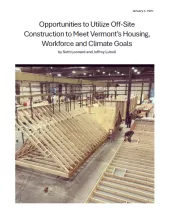
Description: This report explores the potential of off-site construction strategies to reduce the costs of newly developed housing in Vermont, increase Vermont's housing supply, expand manufacturing and well-paying jobs in Vermont, and advance the state’s climate goals.
Description: This 5-year document looks at the current and expected need for housing development in the state by 2029. The Department of Housing and Community Development contracted with the Vermont Housing Financing Agency (VHFA) to complete the 2025-2029 Statewide Housing Needs Assessment. VHFA additionally completed the Statewide and Regional Housing Targets report for DHCD as part of the HOME Act of 2023 and ACT 181 of 2024. The law required DHCD and VAPDA to coordinate to develop regional housing production targets for 2030 and 2050.
Additional Materials:
Fact sheets: Highlights, Demographics, Housing Stock, Renters, Homeowners, Older Vermonters, Large & Small Households, Race & Ethnicity, Homelessness, Special Housing NeedsPrevious Editions: 2020 Vermont Housing Needs Assessment
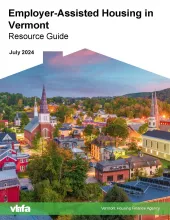
Description: This resource guide reviews options for employers seeking ways to improve the availability and affordability of housing for employees in their communities. It also includes 6 case studies of employer-assisted housing underway in Vermont.
Description: This guide, created by the U.S. Department of Housing and Urban Development, is designed to help you navigate some of the key programs that are funded by HUD that involve rental assistance, homeownership, homelessness, housing counseling, and fair housing.
Additional Materials:
Description: A ‘Design & Do’ Toolkit for Small-scale Home Builders, Investors, and Community Leaders
Description: As housing grows as a concern, opportunity, or both, the knowledge of local leaders can serve as a resource for approaching similar scenarios in other downtowns and neighborhood commercial districts. This guidebook leans on insights sourced directly from experienced Main Street leaders. Alongside their guidance and additional findings from MSA’s research, this report highlights examples of Main Street housing projects and programming to ground the guidebook with relevant stories of challenges and achievements.
Description: The Vermont Housing Needs Assessment Guide is intended to assist community groups determine the need for affordable housing within their cities or towns. This assessment is a tool for collecting, organizing and analyzing information specific to individual communities for use by people with varying familiarity gathering data, including citizens who may have little or no prior experience in the housing field, as well as town staff or other professionals.
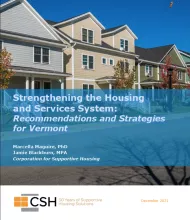
Description: The challenge of responding to the homelessness and housing instability and the COVID-19 pandemic have highlighted the need for housing and services to be aligned more effectively in communities across the state. At the request of the Vermont Housing Finance Agency (VHFA) and the Vermont Housing & Conservation Board (VHCB), CSH convened a Steering Committee of leaders across the state to develop solutions.
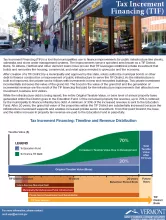
Description: Tax Increment Financing (TIF) is a tool that municipalities use to finance improvements for public infrastructure like streets, sidewalks and storm water management systems. The improvements serve a specified area known as a TIF District, where public infrastructure is required to encourage private property development. Financially, incremental tax revenues generated by the private property development within the District are set aside for a certain period of time to service the public infrastructure debt.
Additional Materials:
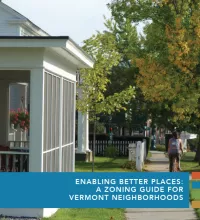
Description: This Guide is structured to enable a planning department or local government to address those topics that have the most significant impact on the affordability of housing in Vermont. Many of the recommendations can be used throughout the state, but they have been developed specifically for village and town centers and nearby neighborhoods.
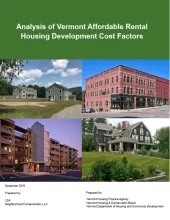
Description: The primary objectives of this study are to examine factors affecting the cost of affordable rental housing and to provide achievable recommendations to contain or reduce total development costs without sacrificing housing quality or other critical policy objectives. This report builds on prior studies of housing costs in the State, as well as recent national research on cost effectiveness in the affordable housing delivery system.